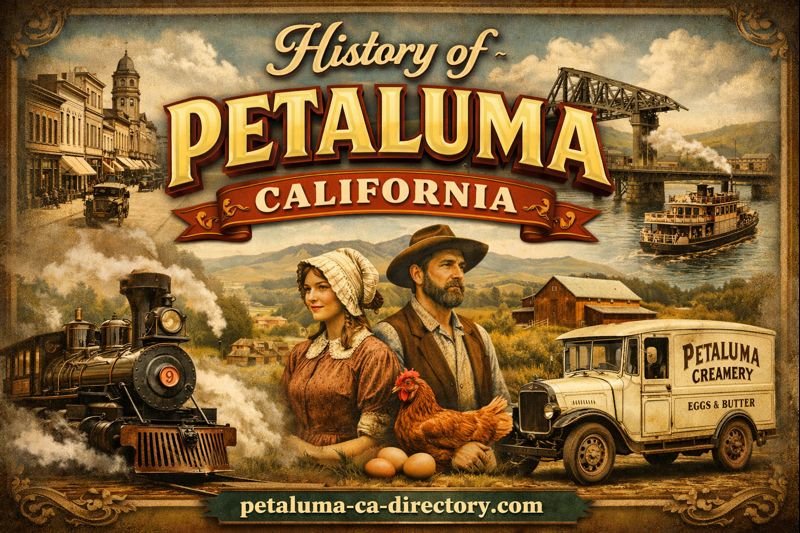
History of Petaluma, California
A River Town Rich in Heritage
The Land Before Settlement
For more than three thousand years before European contact, the Coast Miwok people called this region home. The village of Péta Lúuma, meaning “flat back” or “sloping ridge” in the Coast Miwok language, sat along the banks of what is now the Petaluma River. Several other Coast Miwok villages dotted the surrounding area, including Wotoki, Etem, Likatiut, and Tuchayalin near present-day downtown. The fertile lands and navigable waterway provided abundant resources for these indigenous communities.
Spanish and Mexican Era
In 1834, the Mexican government granted Rancho Petaluma to General Mariano Guadalupe Vallejo, a prominent Californio statesman who is considered the founder of modern Petaluma. Vallejo established the Petaluma Adobe, a large ranch headquarters that served as the center of his agricultural operations. The adobe still stands today as a California State Historic Park, representing one of the largest and best-preserved adobes in Northern California.
Gold Rush Growth and City Founding
The California Gold Rush of 1848 transformed Petaluma from a quiet ranching area into a bustling commercial center. While prospectors flooded the Sierra Nevada, settlers recognized Petaluma’s strategic value as an agricultural supply point. The city was founded in 1852 and officially chartered in 1858, making it one of California’s oldest cities and the oldest between San Francisco and Eureka.
The Petaluma River proved essential to the city’s early prosperity. Sailing scows, schooners, and steamers transported agricultural goods to San Francisco, feeding the growing population during the Gold Rush. By 1880, Petaluma had become the largest shipping point for dairy products in all of California. During the peak of the riverboat era, there was more tonnage and dollar value hauled on the Petaluma River than on any other river in the state.
The World’s Egg Basket
Petaluma’s most famous chapter began in 1879 when Lyman Byce invented the first commercially successful egg incubator. This redwood box device used a coal oil lamp as its heat source and could hatch 400 eggs with a 95 percent success rate. This breakthrough, combined with the introduction of the highly productive Single Comb White Leghorn chicken in the early 1890s, launched an industry that would define the city for generations.
By 1918, Petaluma was proclaimed the “Egg Basket of the World,” complete with a National Egg Day celebration and parade led by an Egg Queen. The city’s poultry ranches peaked in the mid-1940s, producing over 600 million eggs annually. At one point, Petaluma was home to six million hens and had more money on deposit in its banks, per capita, than any other town on Earth.
The poultry industry spawned unique businesses, including the Chicken Pharmacy, started in 1923 by James Keyes. Featured in Ripley’s Believe It or Not as the world’s only drugstore devoted to poultry health, it reportedly sold as many as 50,000 poultry medications in pill form in a single day.
Architectural Heritage
The prosperity of the late 19th and early 20th centuries left Petaluma with remarkable architectural heritage. The city boasts some of the finest examples of iron-front building architecture in the entire United States. The Petaluma Historic Commercial District is listed on the National Register of Historic Places, featuring ornate buildings from the 1860s through 1890s.
Much of Petaluma’s distinctive character is attributable to architect Brainerd Jones, whose career spanned five decades beginning around 1900. Jones designed everything from Victorian homes to Arts & Crafts bungalows, the Carnegie Library (now the Petaluma Historical Library & Museum), and the downtown Post Office. The residential streets surrounding downtown showcase architectural styles including Queen Anne, Victorian Stick, Spanish Revival, Colonial Revival, and Gothic Revival.
Remarkably, Petaluma escaped the destruction of the 1906 San Francisco earthquake that devastated many other Bay Area communities, preserving its historic building stock for future generations.
Need a Website for Your Petaluma Business?
The Inventor’s Velocity offers professional web development and digital marketing services to help local businesses thrive online.
Contact Us TodayHollywood Discovers Petaluma
Petaluma’s well-preserved historic character has made it a favorite filming location for Hollywood. In the summer of 1972, George Lucas filmed much of his iconic film American Graffiti on Petaluma Boulevard and surrounding streets after being denied continued filming in San Rafael. The classic 1973 film, which was nominated for five Academy Awards including Best Picture, captured the essence of small-town America and launched a wave of 1950s nostalgia in American pop culture.
Other notable films shot in Petaluma include Peggy Sue Got Married (1986) starring Kathleen Turner and Nicolas Cage, Flubber (1997) with Robin Williams, Howard the Duck (1986), and Explorers (1985) featuring young Ethan Hawke and River Phoenix. Even Ronald Reagan’s famous “Morning in America” campaign commercials from 1984 were filmed almost entirely in downtown Petaluma.
Growth Management Pioneer
In the 1970s, Petaluma made national headlines for implementing one of the nation’s first growth management ordinances. The city’s controlled development plan, designed to preserve its small-town character and surrounding green space, was challenged by the Construction Industry Association but upheld by the 9th Circuit Court in 1975. The Supreme Court denied a petition for writ of certiorari in 1976, establishing a legal precedent that still forms the foundation for most local growth management ordinances in California.
Modern Petaluma
Today, Petaluma is home to approximately 60,000 residents and serves as a local hub for the Petaluma Valley region of Sonoma County. The city has evolved from its agricultural roots to become home to notable companies including Amy’s Kitchen, Lagunitas Brewing Company, Clover Sonoma, and Petaluma Poultry. The U.S. Coast Guard operates Training Center Petaluma nearby, training thousands of service members annually.
The annual Butter and Eggs Day parade each April celebrates the city’s poultry heritage, while the Salute to American Graffiti draws classic car enthusiasts from across the country. The Petaluma River, once crowded with commercial vessels, now attracts kayakers, paddleboarders, and bird watchers, continuing its role in the community’s vitality.
From Coast Miwok village to Mexican rancho, from world egg capital to beloved film location, Petaluma’s rich history is preserved in its iron-front buildings, Victorian homes, and the continuing spirit of its residents who take pride in their unique heritage.
Visit Petaluma’s Historic Sites
- Petaluma Adobe State Historic Park
- Petaluma Historical Library & Museum
- Historic Commercial District (National Register)
- Mystic Theatre (American Graffiti filming location)
- Victorian home walking tours